I think Cole Butler is the best candidate for Sheriff that Rogers County has ever had the opportunity to elect.
Wednesday, August 01, 2007


Friday, May 04, 2007
Oklahoma Native Heritage Kept Alive by Pocahontas Club


The winds of Oklahoma travel over the prairies sweeping through the valleys and vast landscapes whispering with the echoes of a history that cries out to be remembered. This is Oklahoma a native land, the land of the red man, where landscapes of rolling hills and wide-open prairies meet. Nature begins as civilization pauses to breathe in the sights, which surround every essence of life. If we listen closely to the whispers we might hear, the stories passed down from one generation to another keeping Oklahoma’s Native history alive.
As Oklahomans gather to celebrate 100 years of statehood, it is important to remember the heritage that is the foundation of Oklahoma’s history. One such group has been keeping that history alive for over 100 years. Several women, who were all of Cherokee origin, began a Club in 1899. They were students at the Cherokee Seminary School for girls in Tahlequah. When school was not in session, they longed for the social camaraderie they had at school. One weekend they gathered in the Coowee Scoowee district and decided they would begin a club ~ a purely social club.
These were ladies and their education would rival that of any higher education institution back east. Their studies of history lead them in the choice for the name of their club. The name they chose derived from this country’s first Indian heroine, the maiden Pocahontas, whose story they found exciting. Thus began the Pocahontas Club, with the ultimate goal of “preserving the past for the future.” They would meet monthly on the second Saturday and have book reviews and special speakers to enlighten, educate and entertain.
To be a member of the Pocahontas Club you must be female and you must be a card carrying Cherokee. The Pocahontas Club is a virtual who’s who of the Cherokee Nation and at one point in the very early years; they allowed men to be members. During that time, Oklahoma’s Native Son Will Rogers joined their ranks. All to soon the Pocahontas members began seeing opportunities to help their tribe and the club began a tradition of service. Today the Pocahontas Club continues to thrive through their descendants.
In the Pocahontas Club collect, it states, “…The pride of our race we will forever cherish that its history and legends will not perish…this torch we pass to those who come our place to take…” In keeping with those words spoken for the first time so long ago, the members of the Pocahontas Club continue to treasure tribal traditions and keep the past alive for new generations.
The Women of the Pocahontas Club have always been true champions for education ~ teaching, tutoring, mentoring, and financing those students needing an extra hand. The Club has for generations sent clothing and care packages to the mission orphanages, which housed Indian children. Toys, magazines, layettes and other items have been given to the Indian hospital, and scholarships have been made available to many students through the years. Since the beginning, the Club has acquired projects and other purposes all with the goal of preserving their heritage for younger generations.
One of the most active Pocahontas members is Will Rogers’s great niece Doris “Coke” Meyers. At the young age of 87 “Coke” is far from slowing down. She is enjoying life and all it has to offer. One of her most cherished activities is being a member of the Pocahontas Club. “There are a lot of things that are important...” she said. “Keeping our native heritage alive so the children of tomorrow can remember their roots is very important”. “Coke” has lived an exciting life and her stories have much of the same character of her Uncle Will. When asked where the nickname “Coke” came from she’ll lean over a whisper with a sly smile “because I’m the real thing” and the real thing she is, because Doris “Coke” Meyers is the very model of a Pocahontas member.
“Coke” and her friend Ollie Starr are a force to be reckoned with when they get together. Ollie is very busy constantly talking and considered one of the movers and shakers of the Pocahontas Club. “They see me coming sometimes” she grinned. Ollie will tell you she went to Hollywood and became a star. She then will laugh and explain she went to Hollywood, Florida and Married Mr. Star.
Coke and Ollie are an enjoyable pair they have the heart to serve and preserve the traditions of their Cherokee culture. Currently their time is spent with the Pocahontas Club planning an Old Fashioned Family Picnic at the Dog Iron Ranch, the birthplace of Will Rogers. The club has a history of celebrating Oklahoma’s statehood, and with this being a centennial year, they thought this was the best time to revive a Pocahontas tradition of a Picnic for the families and friends of the club.
“This picnic is a time where we will be celebrating and honoring the members of the Pocahontas Club who are 80 years old and older and raising funds for the Pocahontas scholarship that we reward to a deserving student every year”, explained Ollie.
On Saturday May 19, 2007 at 11 a. m. the Club will honor 33 members who have attained Honorary Status (80 + years of age). They will be recognized for their contributions to education. “And we want families to attend and experience a little history first hand” said Ollie. At 11 a. m., the new officers will be installed and the Verdigris High School Jazz Band will escort a parade with the honorees and special guests up to the front porch of the old homestead.
The cost is $10 for adults and $5 for children 12 and under. The meal will include cornbread and beans served chuck wagon style, BBQ, and Indian fry bread. Paul Bogart a native from Oologah who currently lives in Nashville will headline the entertainment. “He’s a real cowboy who sings and does rope tricks” said Ollie.
An assortment of activities with native artists demonstrating Indian games, a stomp dance, basket weaving and bead working are scheduled. “The day is not only a celebration of our elders but a celebration of the heritage they all hold dear,” said”, “Coke”.
While it is appropriate to respect all elders, those who are actively involved in giving back to the community are the real role models. The women of the Pocahontas Club have a virtuous history of service to the native and local communities and they make it seem easy! They live by the Pocahontas motto: “Speak kind words and you will hear kind echoes…” Come, show your honor and respect to these ladies who unselfishly continue to give back and carry on a heritage where Oklahoma’s deepest roots reside.
The two are still trying to find sponsors for the event. The cost of this type of celebration has greatly escalated in the last 108 years since the club’s formation. If you are interested in attending or becoming a signature sponsor contact:
Doris “Coke” Meyer 283-8092 or Ollie Starr 283-1588.
Email: jjdermody03@sbcglobal.net
Principal Matrilineal Sponsor - $500 (includes 10 tickets)
Deputy Matrilineal Sponsor - $250 (includes 5 tickets)
Matrilineal Host - $100 – (includes 2 tickets)
Individual Ticket: Adult $10-Children $5(Age 12&under)
Deputy Matrilineal Sponsor - $250 (includes 5 tickets)
Matrilineal Host - $100 – (includes 2 tickets)
Individual Ticket: Adult $10-Children $5(Age 12&under)
Please mail to “Pocahontas Picnic”
C/o M.J. DeLozier
P.O. Box 8,
Chelsea, Ok. 74016.
918.789.2398
Monday, April 30, 2007
Joyce at the Inhofe Fundraiser with Vice President Cheney


We talked with Congresswoman Mary Fallin and Senator Jim Inhofe. Joyce told them she would be visiting D.C. in June with her cousins and they told her to be sure and stop by their offices. The day was full of excitment including the end of the day were we got to drive by the protesters that made up about 18 people. Then we heard on the news where there were 60.... don't know where they got their numbers...
Tuesday, April 24, 2007
A Visionary Who's Sands Ran Out of Time
Collinsville, Oklahoma is a quaint community just north of Tulsa that beckons antique shoppers from miles away. Shoppers will spend the day strolling down the Historical Main Street seeking hidden treasures in one shop after another. Little do they know that Collinsville has a secret treasure of great magnitude. This treasure, which is nestled in the dark recesses of an old building that looks to be vacated, continues to wait for the treasure hunter to uncover its bounty.
The sign is weathered, “Woodruff’s for Spacious Skies ~ a Gallery of the Arts” it states. The display windows are dilapidated and in disarray with old posters and bunting faded by time. The rickety wooden doors have cracks in the paint and the curtains are torn. The typical passerby would pay no attention to the building as it appears to be abandoned. The treasures this building holds within stays hidden from view until the keeper unlocks the doors and reveals the magnificence that is held inside its walls.
The keeper of the key is Dianne Newhouse the friend of the late Dianne Woodruff who attained minor attention for her series on the State Capitols and Presidents. Woodruff a native of Oklahoma lived for years in the Swan Lake district while married. Her passion for art and creativity and an unhappy marriage drove her to the San Francisco area for some 20 years. After being discovered by the art world Woodruff came home to Oklahoma and landed in the town of Collinsville, a place, she had visited frequently in her earlier days.
Dianne Woodruff was a driven woman who’s vision for the extraordinary and out of the ordinary captured the curiosity of the Collinsville community. In 1980, Woodruff came to Collinsville and began to turn it on its ear. Her vision of the Land of Oz and the yellow brick road was met with both criticism and praise. She purchased two buildings herself and began renovations and collaborated with the late Mrs. Holman on a third. Her vision began taking form as several other community leaders caught on to her tail feathers.
Woodruff’s art is large, she created on a huge scale and her creations were deceiving as they looked like they weighed a ton. The grand scale murals are three dimensional, she invented a process by where she used a concoction on Styrofoam so she could carve and paint making the pieces look like stone, wood, and metal. Her attention to detail is evident in her pictures depicting Washington D.C. She uses a multitude of mediums incorporating them into a picture that looks like the viewer could step into the scene.
Woodruff’s eye for detail is unmistakable in her creations of the presidents. With in each picture of the presidents pictures are hidden which reflect the life and times of the president. Her portrayal of President Ford at first glance looks to be just of a man swimming. Upon closer examination, the viewer is able to see a host of figures and words. It would take hours of viewing on multiple days to take in the entire display. Woodruff’s pictures are busy, but that busyness only adds to the visual enjoyment.
According to Newhouse, Woodruff painted like a maniac on many occasions spending 15 to 20 hours strait on a painting. “Once she would get an idea in her mind she would not stop until she had the completed idea on paper,” said, Newhouse. Woodruff’s last project was designing the huge murals for downtown buildings in Atlanta for the 1996 Olympics. She was not able to complete the project as she died of cancer on November 19, 1993.
The desire on Woodruff was to open a Gallery and utilize it as a teaching facility to further the creative arts in higher education. The Gallery is filled with Woodruffs works but her dream was never fulfilled as the sands in the hourglass of her life ran out way to soon.
The sign is weathered, “Woodruff’s for Spacious Skies ~ a Gallery of the Arts” it states. The display windows are dilapidated and in disarray with old posters and bunting faded by time. The rickety wooden doors have cracks in the paint and the curtains are torn. The typical passerby would pay no attention to the building as it appears to be abandoned. The treasures this building holds within stays hidden from view until the keeper unlocks the doors and reveals the magnificence that is held inside its walls.
The keeper of the key is Dianne Newhouse the friend of the late Dianne Woodruff who attained minor attention for her series on the State Capitols and Presidents. Woodruff a native of Oklahoma lived for years in the Swan Lake district while married. Her passion for art and creativity and an unhappy marriage drove her to the San Francisco area for some 20 years. After being discovered by the art world Woodruff came home to Oklahoma and landed in the town of Collinsville, a place, she had visited frequently in her earlier days.
Dianne Woodruff was a driven woman who’s vision for the extraordinary and out of the ordinary captured the curiosity of the Collinsville community. In 1980, Woodruff came to Collinsville and began to turn it on its ear. Her vision of the Land of Oz and the yellow brick road was met with both criticism and praise. She purchased two buildings herself and began renovations and collaborated with the late Mrs. Holman on a third. Her vision began taking form as several other community leaders caught on to her tail feathers.
Woodruff’s art is large, she created on a huge scale and her creations were deceiving as they looked like they weighed a ton. The grand scale murals are three dimensional, she invented a process by where she used a concoction on Styrofoam so she could carve and paint making the pieces look like stone, wood, and metal. Her attention to detail is evident in her pictures depicting Washington D.C. She uses a multitude of mediums incorporating them into a picture that looks like the viewer could step into the scene.
Woodruff’s eye for detail is unmistakable in her creations of the presidents. With in each picture of the presidents pictures are hidden which reflect the life and times of the president. Her portrayal of President Ford at first glance looks to be just of a man swimming. Upon closer examination, the viewer is able to see a host of figures and words. It would take hours of viewing on multiple days to take in the entire display. Woodruff’s pictures are busy, but that busyness only adds to the visual enjoyment.
According to Newhouse, Woodruff painted like a maniac on many occasions spending 15 to 20 hours strait on a painting. “Once she would get an idea in her mind she would not stop until she had the completed idea on paper,” said, Newhouse. Woodruff’s last project was designing the huge murals for downtown buildings in Atlanta for the 1996 Olympics. She was not able to complete the project as she died of cancer on November 19, 1993.
The desire on Woodruff was to open a Gallery and utilize it as a teaching facility to further the creative arts in higher education. The Gallery is filled with Woodruffs works but her dream was never fulfilled as the sands in the hourglass of her life ran out way to soon.
Dada Rules
What is Dada?
Explaining what the word came to mean may be simple however, its birth is a little foggy. The name Dada was taken but its development was argued amongst its founders sometimes with great passion and other times with a tongue-in-cheek attitude. The most popular version of the story is that the word was picked at random from a French-German dictionary using a sharp knife and stabbing the book. The result was Dada a "hobby horse" in French. At any juncture, the catch phrase made the least amount of sense was "Dada”, so Dada it was.
Explaining what the word came to mean may be simple however, its birth is a little foggy. The name Dada was taken but its development was argued amongst its founders sometimes with great passion and other times with a tongue-in-cheek attitude. The most popular version of the story is that the word was picked at random from a French-German dictionary using a sharp knife and stabbing the book. The result was Dada a "hobby horse" in French. At any juncture, the catch phrase made the least amount of sense was "Dada”, so Dada it was.
Dada History
History shows that the performances at the Cabaret Voltaire were the beginning of what began the movement that was a non-movement. It was the beginning of 1916 and Hugo Ball, a German industrious objector arrived in Zurich and rented an empty hall belonging to Ephraim Jan, an elderly Dutch sailor who was running a "Dutch Room" at the "Meierei", at Nr. 1 Spiegelgasse, Zurich. There, Ball, with his wife Emmy Hennings planned to open his own cabaret theater. For a name, they chose "Cabaret Voltaire." Their choice of name for the Cabaret had its own roots as it was the name sake of François-Marie Arouet 1694-1778, better known by the pen-name Voltaire, who was a French Enlightenment writer and philosopher who was a satirist; remembered as an advocate against cruelty. Voltaire represented wise cynicism against the establishment of his time. Accordingly, the Cabaret Voltaire began and the proprietors set out to enlighten the world to their plight.
Ball wrote in his Diary “Every word spoken or sung here says at least one thing ~ that these humiliating times have not succeeded in wresting respect from us.”
Ball and his wife asked Hans Arp, Marcel Janco and Tristan Tzara, members of their circle, to collaborate, and the cabaret was opened on February 5, 1916. The Cabaret Voltaire was a shadowy building providing an artists’ club, exhibition room, pub, and theater, all rolled into one. It accommodated fifty people at a time and became the hot spot for students and well-to-do Swiss burghers. The artists’ performances consisted of unique unheard of never before been seen poems, song, art and music. Noise music, simultaneous poems recited by four to seven voices speaking all at once, bizarre dances in grotesque masks and fancy costumes, interrupted by readings of German and French sounding verses. This menagerie of conglomerated noises sounded like nothing on Earth. Solemn incantations of texts by the mystic Jacob Boehm and of Lao-Tse were spoken in monotone. Walls were adorned with pictures by artists whose names had been unfamiliar until then: Arp, Janco, Kisling, Paolo Buzzi, Cangiullo, Macke, Marinetti, Modigliani, Mopp, Picasso, van Rees, Slodki, Segal, Wabel, and others.
The War and Dada
The Dadaists believed that the cataclysm of the Great War was the unavoidable consequence of old, dishonest, xenophobic cultural values of European civilization and its political, philosophical, and artistic traditions. The driving force of Dada was to compel audiences to question all traditions, all artistic forms and formulas, including even the language on which all literature and all thought were based. They did not aim to set up new paradigms, new principles, and new proverbs to take the place of the old. They wanted to create anarchy ~ a war on the establishment and all those ~ who in the Dadaist point of view ~ were narrow-minded. At least seventy-five years before the Dadaists burst onto the scene, many artists and writers had already recognized that the bankruptcy of official culture in nineteenth-century Europe left the fate of culture in the hands of a self-appointed minority, which like all self-appointed minorities would be constantly struggling to establish its legitimacy and clarify its direction. Although the Dadaists dreamed of shocking a large swath of the middle class, and did at times aim to connect with the working class, one suspects that their audience was mostly very small and made up of the progressive and the artistically minded.
Dada Style
When a close examination of the visuals created by the Dada artists started, some began to speculate as to the artists’ state of mind and weather they were on hallucinogenic drugs. The capricious, multicolored cleverly mocking and many times mad works were hard to comprehend for closed-minded individuals. Dada had only one rule: Never follow any known rules. Dada art is senseless to the point of whimsy. However almost all Dadaists were ferociously serious about what and why they did what they did. Unlike other art eras, the Dada had no principal medium. All things from geometric tapestries to glass to plaster and wooden reliefs were fair game. Once the Dadaists had rejected the framed oil painting and the sculpture on its pedestal in favor of photography, typography, collage, assemblage, the found object, and the Readymade, they were to some extent fated to wind up producing trinkets and trophies. It is worth noting, though, the use of these out of the norm objects gained wide acceptance due to their use in Dada art. They were influenced mainly by Abstraction and Expressionism followed by Cubism and, to a lesser extent, Futurism. Dada is a state of mind it transforms itself according to races and events of the day. Dada applies itself to everything, and yet it is nothing, it is the point where the yes and the no and all the opposites meet, not solemnly in the castles of human philosophies, but very simply at street corners, like dogs and grasshoppers.
The Dada Agenda
Ball professes the philosophy of Dada, which consists of three major points, "1. Dada is international in perspective and seeks to bridge differences, 2. Dada is antagonistic toward established society in the modern avant-garde, Bohemian tradition of the épater-le-bourgeios posture, and three. Dada is a new tendency in art that seeks to change conventional attitudes and practices in aesthetics, society, and morality." Dada was culture of contemporary reasoning: a culture where expression of personal values exuded. Of course, the Dadaists were disposed to the belief that in the modern world personal values were on the verge of being considered outlandish behavior. Moreover, they were not above masquerading what should have been considered candid opposition to old-fashioned humanism behind their own kind of original pretentiousness. Dada represented the avant-garde in revolutionary terms. Dadaists wrote manifestos which answered questions that loomed as to their propensity to create the artistic works that were difficult for the closed minded to understand or appreciate.
In 1923, only a day and a half before one of dada's major Paris events, Man Ray discovered he was listed on the program as the director of an experimental movie – something in which he had yet to try his hand. Instead of running off to shoot some scenes, he dropped various objects on his film before exposing it to light, then edited in snippets of footage he happened to have from previous experiments with film. These snippets Included scenes of a shadow-caressed female torso from which he took one of his most famous still photos. The two-minute silent film, titled "Return to Reason," was unreasonable, incoherent and aggressive; its first screening incited a riot. What more could any dada artist ask?
During the height of the Dada movement avant-gardism became an argument not only concerning the path of art but about the implication of art, and whether artists, who were by their very character a minority, could ever grasp their dreams. The Dadaists had the stance, which, continued to remind their fellow artists and writers ~ artistic accountability has no particular form, but depends on the ability of the artists’ relentlessness to conceive and re-invent a diversity of styles.History shows us that Dada self-destructed when it was in danger of becoming "acceptable".
Dada Influence
A century later, we can begin assessing the Dadaist’s quest with more enlightenment. What is most salient is the passion Dada artists expressed in their art. Even when they challenged the influence of art, they were acknowledging its power and what it meant to them. (Riding, 2005). For something that supposedly meant nothing, Dada certainly created many offshoots. In addition to spawning numerous literary journals, Dada influenced many concurrent trends in the visual arts (especially in the case of Constructivism). The best-known movement Dada was directly responsible for is Surrealism.
A century later, we can begin assessing the Dadaist’s quest with more enlightenment. What is most salient is the passion Dada artists expressed in their art. Even when they challenged the influence of art, they were acknowledging its power and what it meant to them. (Riding, 2005). For something that supposedly meant nothing, Dada certainly created many offshoots. In addition to spawning numerous literary journals, Dada influenced many concurrent trends in the visual arts (especially in the case of Constructivism). The best-known movement Dada was directly responsible for is Surrealism.
Challenges for Today’s Dada Artist
The challenge that faces a would-be Dadaist today is the same challenge that faces any painter or sculptor, namely to recapture the visionary optimism that is the heart and the soul of the artistic enterprise. The contrast between Dadaism then and Dadaism now is going to unsettle a lot of assumptions about the nature of this movement that erupted in the midst of World War I, and about how the Dadaist gene pool--which contained nihilism and quietism, politicization and aestheticism, hyper-personalization and de-personalization--has shaped the anything-goes sensibility of the present.
Closing the Dada Quest
Nobody will ever agree about the extent to which the Dadaists regarded art as a tool for social transformation, or saw the rejection of the high art traditions as a statement about the obsolescence of tradition in general, or were mostly interested in reshaping art. Just as Surrealism facilitated the shaping of modern perceptions, Dada persists to stir artists’ creativity. Abstract Expressionists and the "happenings" of the 1960s, which echoed the Cabaret Voltaire; and conceptual artists like Damien Hirst and Sarah Lucas owe much to Duchamp and Dada. Where the difference lies, though, is that Dada is now part of an evolutionary process. The shock has largely disappeared. Dada's aesthetic values may even have triumphed, but its political message is ancient history. Today, many artists like to shock, not to overthrow the art establishment ~ but to join it. Whatever particular artists or poets happened to believe--and surely many people thought different things at different times--Dada as a whole must be understood in relation to the broader trend of the avant-garde. To truly appreciate Dada art it is crucial to remember the number one rule ~ Never follow any known rules.
Monday, April 23, 2007
"Like This"

I entered this photo in the Rogers County Casa Photo contest that's theme was 'Honoring the Family' and I won! It is currently being made into a poster that will promote the CASA group in Claremore. It is quite the honor.
The CASA mission is to speak for the best interests of abused and neglected children in the courts of Rogers, Mayes, and Craig counties. We promote and support quality volunteer representation for children to provide each child a safe, permanent, and nurturing home.
CASA (Court Appointed Special Advocates) is an organization of volunteer citizens who advocate for the best interests of children caught up in our court system due to neglect and abuse.
Contact:
Angela Henderson
Phone:
(918) 343-1515
Fax:
(918) 343-0808
P.O. Box 1468510 E. Will Rogers Blvd.Claremore, OK 74018
Friday, November 10, 2006
Respect and Honor to Our Troops
A few days ago, Senator John Kerry spoke a scathing remark, which angered service men and women around the world. Senator Kerry said, “If you … do your homework, you make an effort to be smart, you can do well. If you don’t, you get stuck in Iraq.” These words resounded around the globe to the men and women who are currently in harms way. Kerry may have thought he was being a brilliant speaker but he again proved himself a babbling baboon in a suit.
I personally take offense at his remarks because some of the most intelligent men I have ever known have served and many are still serving in the Armed Forces. My Brother-in-Law is a retired Physician who served during Vietnam. My Husbands cousin served as the Admiral of the Kitty Hawk. My Cousin Lynda is a retired Cornel in the Army and my other cousin’s husband Piloted Marine One. Two of my grand parents fought in WWII and witnessed the atrocities of the German occupation and death camps. These are all extremely intelligent people who have fought in wars that were looked on in ridicule at one time or another.
Today my brother and our young cousin are awaiting deployment to Iraq. Both of these men are very intelligent and have men in their units, which they command many of whom have Masters Degrees and several who are working on their Doctorate thesis. To imply that these men and women who are serving unselfishly in foreign lands are not smart is preposterous. People who spout that kind of venom should be muzzled. Kerry is not smart enough to keep his mouth shut on his own he has proved this over and over again.
Let us remember our Veterans and Military with respect and Honor, they deserve far more.
I personally take offense at his remarks because some of the most intelligent men I have ever known have served and many are still serving in the Armed Forces. My Brother-in-Law is a retired Physician who served during Vietnam. My Husbands cousin served as the Admiral of the Kitty Hawk. My Cousin Lynda is a retired Cornel in the Army and my other cousin’s husband Piloted Marine One. Two of my grand parents fought in WWII and witnessed the atrocities of the German occupation and death camps. These are all extremely intelligent people who have fought in wars that were looked on in ridicule at one time or another.
Today my brother and our young cousin are awaiting deployment to Iraq. Both of these men are very intelligent and have men in their units, which they command many of whom have Masters Degrees and several who are working on their Doctorate thesis. To imply that these men and women who are serving unselfishly in foreign lands are not smart is preposterous. People who spout that kind of venom should be muzzled. Kerry is not smart enough to keep his mouth shut on his own he has proved this over and over again.
Let us remember our Veterans and Military with respect and Honor, they deserve far more.
Friday, September 08, 2006
Saying I Love You!

This is a picture of Charlene along with Keshia and Tiffany in the background at the going away ceremony in Muskogee yesterday. The Muskogee Phoenix published this picture of her in September 8th paper.
Tuesday, September 05, 2006
A HEROs Send Off

My brother Richard Hines and my cousin Michael Hines both graduates from Collinsville High are on their way to IRAQ for a year and a half stay. They and over 140 other men and women from the Oklahoma Army Guard will be leaving in the morning headed first to Ft. Dix. There they will receive training and briefing on their objective and by Christmas will be headed into harms way. We had the family get together to send them off with prayers and good wishes for their safe return.

Richard married a year ago and two months ago he and his wife Keshia welcomed a bouncing baby boy into the world. Michael has a girlfriend who has added a sparkle to his eyes that has been missing for a long time. Both of these women will have a hard road over this next year. Please pray for them.

The boys (men as my brother continues to remind me) have been trained to be the best they can be. They believe in the reason for their deployment into the middle east. I ask that you pray for a hedge of protection to surround them. Please pray for their courage and inner strength. Pray for their walk with GOD to strengthen and for their safe return.
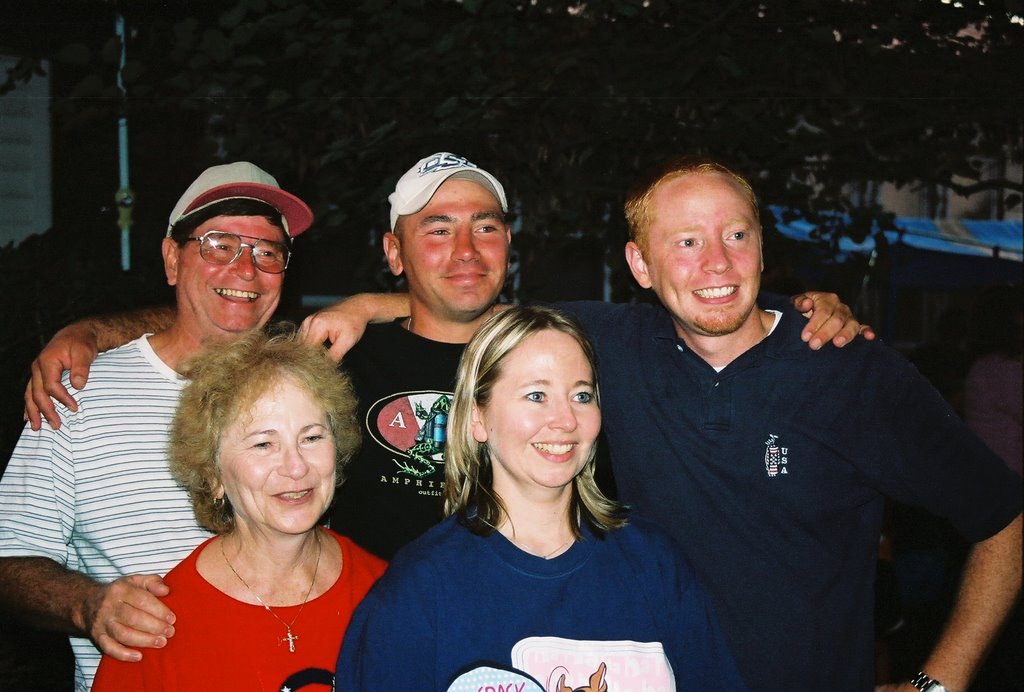
I will continue to post updates along with pictures as I get them. I will keep you posted to specific prayers that are needed.
Friday, August 11, 2006
Taking a Walk in the Woods
What a beautiful place. Nature is so close. This spot is near Campbell Creek right in the populated area. Alaska is the great frontier.

Subscribe to:
Posts (Atom)


 Posts
Posts


